Why Your Facebook Ads Break When You Scale
You found a winner. You increased budget. Performance tanked. Here's the science behind scaling failures and how to avoid them.
The Scaling Trap
You've done it. After weeks of testing, you found a Facebook ad that converts. CPA is hitting your targets. ROAS is solid. You're ready to scale.
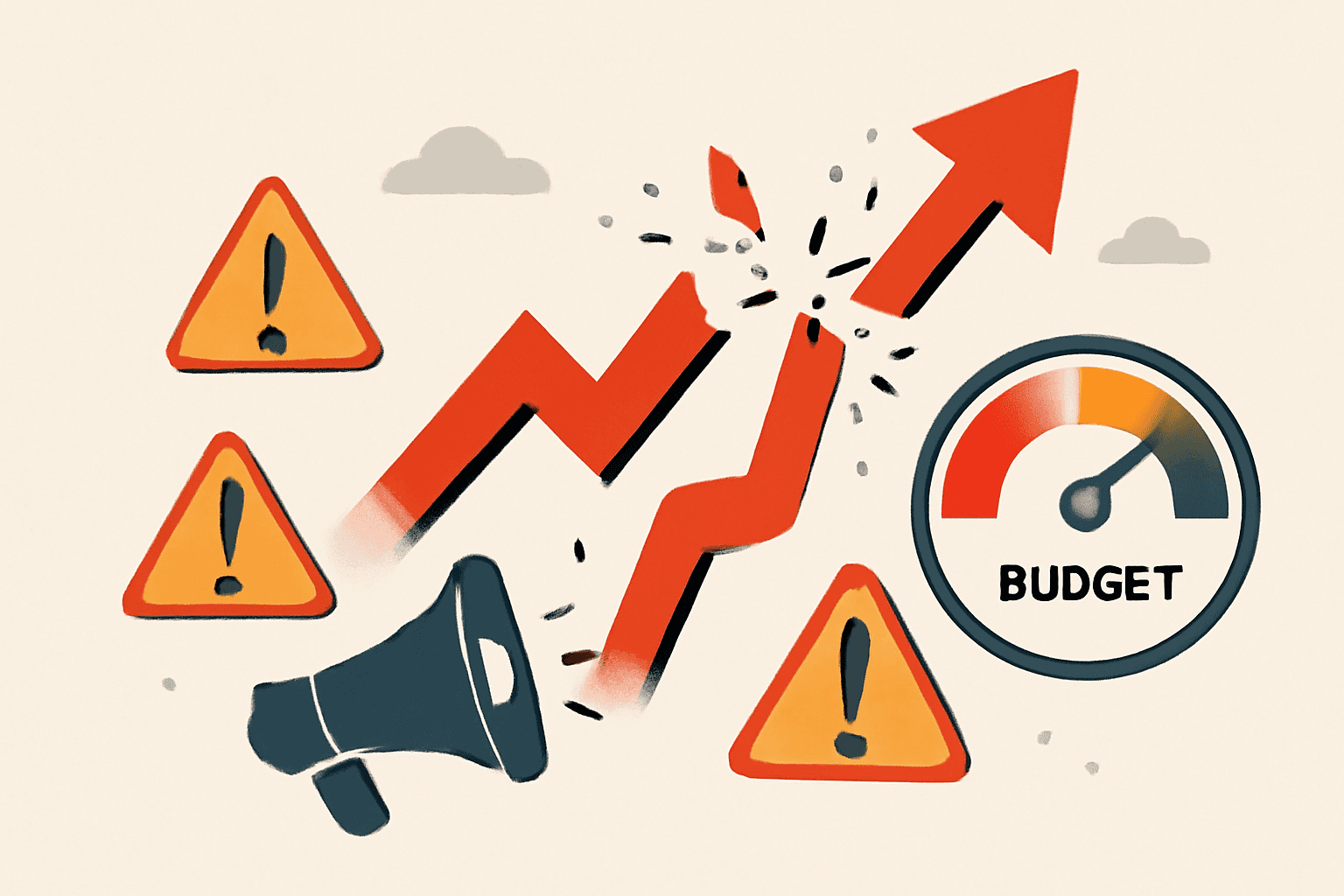
So you increase budget from $100/day to $500/day. Within 48 hours, your CPA doubles and your ROAS tanks.
What happened?
This is the scaling trap, and it catches most advertisers. Understanding why it happens—and how to avoid it—is the difference between ads that scale profitably and ads that collapse under pressure.
Why Scaling Kills Performance
1. The Auction Dynamics Shift
At low budgets, Facebook's algorithm is highly selective. It shows your ad to the most likely converters within your audience—the cream of the crop.
When you increase budget dramatically, you've told the algorithm to spend more money. It still needs to spend that budget, so it expands to less optimal users within your audience.
The math:
- At $100/day, you might reach the top 5% of converters in your audience
- At $500/day, you're reaching the top 25%
- That bottom 20% converts at a much lower rate
2. Learning Phase Restarts
Facebook's algorithm "learns" from your conversion data. When you make significant changes (including budget increases over 20%), the algorithm partially resets and re-enters learning.
During learning phase:
- Performance is less stable
- CPAs fluctuate more dramatically
- The algorithm is experimenting, not optimizing
How long it lasts: Usually 50 conversions or 7 days, whichever comes first. For accounts with high CPAs, this can mean days of poor performance.
3. Frequency and Fatigue Accelerate
Higher budgets mean more impressions in the same time period. If your audience isn't large enough, you'll hit the same people more frequently.
At $100/day: You might show ads to 10,000 people with average frequency of 1.5
At $500/day: You might hit 15,000 people with average frequency of 4.0
That higher frequency burns through your best prospects faster and fatigues your creative more quickly.
The Right Way to Scale
Method 1: Gradual Budget Increases
The safest approach: increase budget by no more than 20% every 3-4 days.
Example timeline:
- Day 1: $100
- Day 4: $120
- Day 8: $145
- Day 12: $175
- Day 16: $210
- Day 20: $250
This keeps the algorithm from re-entering learning phase and allows gradual audience expansion.
Pros: Most stable, lowest risk
Cons: Slow—takes weeks to double budget
Method 2: Horizontal Scaling
Instead of increasing budget on one ad set, duplicate it and run both:
Original campaign:
- Ad Set A: $100/day (proven performer)
After duplication:
- Ad Set A: $100/day
- Ad Set B: $100/day (exact copy)
You've effectively doubled spend without touching the original's algorithm.
Pros: Faster than gradual scaling, maintains original's stability
Cons: Potential audience overlap, need to monitor both ad sets
Method 3: New Campaign Launch
Create an entirely new campaign with higher budget and broader targeting:
- Keep original campaign running as-is
- Launch new CBO campaign at higher budget ($500/day)
- Use broader audience (larger lookalike, broader interests)
- Run winning creative from original campaign
Pros: Can scale quickly, isolates risk
Cons: New campaign needs to re-learn, might not match original performance
Method 4: Audience Expansion
Instead of more budget to same audience, expand the audience:
- Move from 1% lookalike to 2-3%
- Add new interest stacks
- Test broader geographic targeting
- Remove unnecessary exclusions
Larger audience at similar budget = sustainable scale.
The Scaling Checklist
Before scaling any campaign, verify these fundamentals:
Creative Readiness
- [ ] Do you have 3-5 backup creatives ready to deploy?
- [ ] Are your best performers less than 4 weeks old?
- [ ] Do you have different formats (video, static, carousel)?
Scaling burns through creative faster. Have backups ready.
Audience Headroom
- [ ] Is your audience size at least 1M+ for prospecting?
- [ ] Is your current frequency below 2.0 weekly?
- [ ] Do you have room to expand (larger LALs, new interests)?
Tracking Confidence
- [ ] Is your tracking verified and accurate?
- [ ] Are you using CAPI alongside pixel?
- [ ] Is Event Match Quality above 6.0?
Bad tracking becomes worse at scale. Fix it first.
Unit Economics
- [ ] Do you know your break-even ROAS?
- [ ] Is current ROAS at least 30% above break-even?
- [ ] Can you afford CPA increases of 20-30% during scaling?
Scale profitable campaigns, not break-even ones.
What to Do When Scaling Goes Wrong
Scenario 1: CPA Spikes Immediately
Likely cause: Budget increase too aggressive, learning phase restart
Fix:
- Don't panic-cut budget (makes it worse)
- Wait 48-72 hours for stabilization
- If no improvement, reduce budget to 20% above original
- Scale more gradually next time
Scenario 2: Gradual Performance Decline Over 1-2 Weeks
Likely cause: Creative fatigue or audience saturation
Fix:
- Check frequency—if above 3.0, creative is likely fatigued
- Introduce new creative immediately
- Consider audience expansion
- Review first-week vs. recent performance to identify decline point
Scenario 3: Wild Swings Day-to-Day
Likely cause: Still in learning phase or not enough conversion volume
Fix:
- Wait for learning phase to complete (50 conversions)
- If conversions are too expensive, consider optimizing for higher-funnel event temporarily
- Consolidate ad sets to pool conversion data
Advanced Scaling Tactics
CBO vs. ABO for Scaling
CBO (Campaign Budget Optimization):
- Let Facebook distribute budget across ad sets
- Better for scaling because it auto-adjusts to best performers
- Needs multiple ad sets to work well
ABO (Ad Set Budget Optimization):
- Manual control of budget per ad set
- Better for testing, harder for scaling
- Risk of over/under-spending on individual ad sets
Recommendation: Scale with CBO, test with ABO.
The Isolation Test
When scaling, isolate new tests from proven performers:
- Campaign 1: Proven performers only, gradual budget increases
- Campaign 2: New creative tests at controlled budget
- Campaign 3: New audience tests at controlled budget
This prevents tests from disrupting proven campaigns.
Scale by Objective
Not all campaigns should scale the same way:
- Conversion campaigns: Scale gradually, monitor ROAS closely
- Traffic campaigns: Can scale more aggressively, lower stakes
- Engagement campaigns: Scale based on cost-per-engagement trends
The Bottom Line
Scaling Facebook ads isn't about increasing budget—it's about systematically expanding what works while maintaining algorithm stability and creative freshness.
The advertisers who scale successfully aren't the ones who find magic audiences or creative. They're the ones who understand the algorithm's needs and respect the scaling process.
Slow scaling beats fast failure every time.
Struggling to scale past a certain budget level? Our team specializes in Meta ads scaling—building the creative pipeline, audience expansion, and campaign structure needed to scale profitably. Let us audit your account and show you the scaling opportunities you're missing.